


2026:2
Installment two of Affective the Affective is finally here!
Key takeaways
Relevant learning in today’s world requires a substantial amount of “know-who” and “know-how” (affective components) beyond just cognitive knowledge or “know-what”.
Affective skills—such as flexibility, empathy for collaboration, and intellectual humility in critical thinking—serve as “gateways” and catalysts for mastering more cognitive skills, such as information and digital literacy.
The traditional KSA (Knowledge, Skills, Abilities) competency model is suboptimal because it is knowledge-dominant and driven by the convenience of testing, often missing affective elements that are difficult to quantify and test.
The document proposes flipping the script to the ASK (Attention, Skills, Knowledge) model, a learning-centered approach that starts by defining competency in terms of the focus or attention required for successful learning.
Attention is a fundamental gateway to learning; without focused attention, new information is not effectively processed or retained, making attentional capacity a critical prerequisite for knowledge acquisition and skill mastery.
— Second of a four-part series —
The first installment of this series developed the idea that relevant learning in today’s world involves more than cognitive knowledge—the “know what.” The idea is clear. Modern societies demand more than propositional knowledge, the “know what.” Instead, a substantial amount of “know-who” and “know-how” is needed. That’s where the affective journey should begin.
The real journey begins before the ”know-what” cognitive knowledge
This installment of Affecting the Affective takes a deep dive into the area of competencies, and specifically the learning aspect of affective competencies. What I lay out here is that designing and delivering affective skills learning is different from what we think about a competency.
The affective: Enter the 21st Century Skills
A useful framework for understanding the importance of affective skills is the 21st Century Skills Framework. The concepts were developed shortly after the turn of the century by the Partnership for 21st Century Skills (P21), which included the U.S. Department of Education and tech leaders such as Apple, Oracle, Cisco, and Microsoft. The purpose was to align education with the evolving demands of the digital economy. A key shift embedded in the framework was a move away from ideas rooted exclusively in cognitive knowledge acquisition, such as rote memorization and recall, towards higher-order, multi-skilled competencies. The diagram below shows the positioning of key enabling competencies across the top.
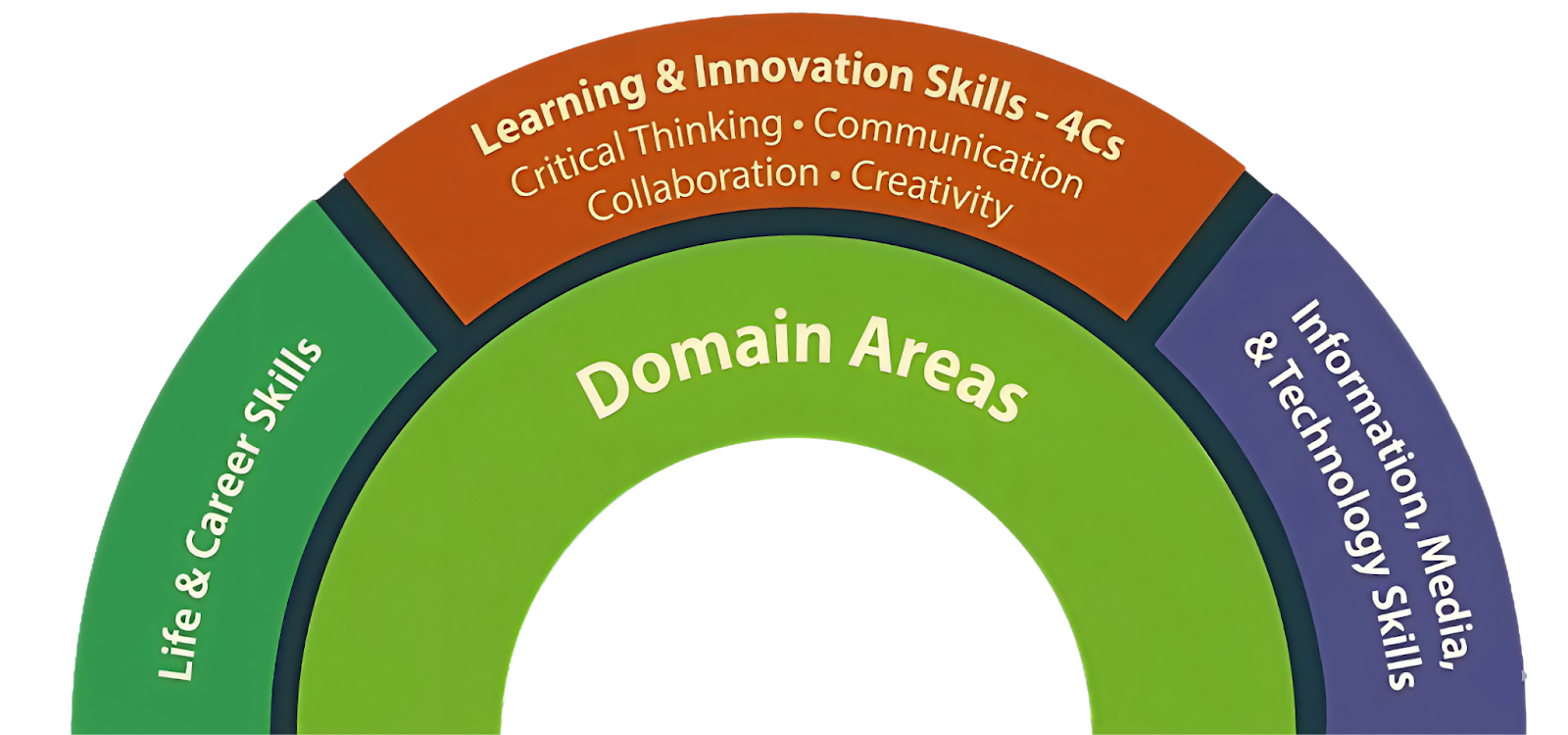
The competencies are divided into three groups as shown below.
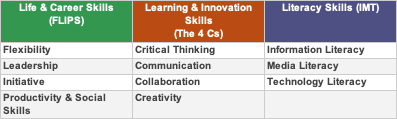
The news headlines about 21st-Century skills often focus on fashionable hard skills such as information and digital literacy. The hidden issue is that even literacy skills, which are typically more cognitive in nature, depend on the key affective elements — the gateways — of life/career and learning skills.
Affective skills serve as the gateways to knowledge
For example, useful flexibility requires significant emotional regulation to manage the anxiety of change while remaining in a growth mindset. Critical thinking, often misconstrued as just a bit of cognitive learning, comes only with a healthy dose of intellectual humility and the ability to challenge one’s prior thinking. Collaboration demands empathy and trust to support valuing and acting on diverse perspectives. Without these affective components, the ability to master the literacy skills is severely limited.
The through line, or the red thread, is that the affective components of key skills serve as catalysts for the mastery of cognitive skills. It is here that we can see the divergence from prevailing notions of knowledge-based competencies, often described using the acronym of KSA for knowledge, skills, and abilities.
Why the KSA competency model misses the mark
KSA, an acronym for Knowledge, Skills, and Abilities, is the traditional and widely adopted framework for defining competencies in educational, learning & development (L&D), and human resource contexts. This model typically positions a competency as a measurable outcome, progressing from foundational knowledge (the “know-what”) to skills (often seen as the “know-how”), and culminating in abilities (often combining “know-how” with context, such as “know-who” and “know-why”). It is a suboptimal choice, but it satisfies the convenience of testing.
The real journey of learning begins with the affective components of know-why and know-who
The history of how competencies entered the educational space points to why knowledge is privileged over affective components. David McClelland of Harvard is often credited with coining the phrase “competency” in his 1973 seminal paper “Testing for Competence Rather than Intelligence.”[1] McClelland, however, did not provide a complete model for defining competence or developing learning models around the idea. He published around the idea but did not develop definitional tools and techniques.
The hidden challenge of McClelland’s work was that competencies are difficult to quantify, measure, or assess. That challenge led to competencies being co-opted by assessment and testing. For example, their article “Use of Knowledge, Skill, and Ability Statements in Developing Licensure and Certification Examinations,” [2] Wang, Schnipke, and Witt trace the origins of the KSA trio to professional licensure exams and testing for specific knowledge recall and reasoning rather than interpersonal skills or abilities. This development flipped McClelland’s idea on its proverbial head. Rather than looking for skills, the focus has shifted towards testable knowledge.
The idea of competencies has been co-opted by testing, not learning and education
It is ironic, in light of McClelland’s suggestions for competency evaluation rather than intelligence testing, that the construction of competencies has ended up relying on a knowledge-dominant KSA model. The purpose of a supposed logical progression from knowledge to skills to abilities appears to be largely for the convenience of testing and not grounded in the realities of learning.
It is not surprising that testing or assessment of knowledge has come to dominate competency discussions. Meaningful assessment of skills and abilities, which are more affective in nature, is difficult. For example, OECD’s 2015 Programme for International Student Assessment (PISA) struggled to assess collaboration (one of the 4-Cs). The problems in that experiment confronted the practicalities of assessing conversations, group composition disparities, and a lack of effective technology to capture interpersonal interactions. [3]
Flipping the script from KSA to ASK
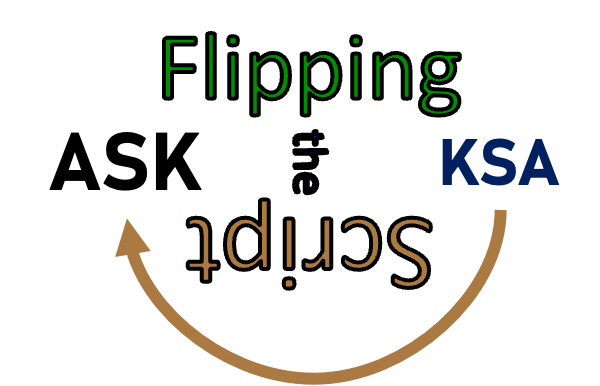
Perhaps we should move beyond a testing-driven view of competencies towards a learning-centered approach. A suggestion is to “flip the script” and think of competencies using the acronym ASK rather than KSA. Several issues with the KSA model suggest that an alternative approach is needed.
For starters, the “K” or knowledge element in the KSA model is not as fixed and certain as many learning designers may believe. In an era of hyper-connectivity and ubiquitous web resources, knowledge is more the result of adept access to and use of data and information in context. It is no longer a fixed set of ideas or concepts that define what needs to be learned. Viewing knowledge as a dynamic rather than a fixed characteristic clearly recognizes the role that web resources play in shaping knowledge generation and acquisition. In short, it cannot be the starting point for defining a competency.
The skills or “S” element in KSA also evades an easy definition. A common approach to defining skills is based on skill domains, which require some level of task consistency and practical value for organizations to structure work. [4] The overlap with notions of abilities is obvious and further leads to confusion in the KSA model. A definition of skills by the ILO is “the ability to carry out the tasks and duties of a given job.” [5] The fusing of ability with skills in the ILO definition illustrates a key challenge inherent in the KSA model.
Beyond the confusion inherent in the fusion of skills and abilities, there is another tension in the use of the ability concept. The classic definition of skills is focused on manual tasks. Such an idea could suffice for rather simple repetitive tasks, such as those on a 20th-century assembly line. The idea quickly falls apart with complex tasks in a knowledge economy. For example, the work of a skilled surgeon involves much more than the repetition of a set of tasks with a scalpel.
A proposed use of ASK starts with a competence based on attention
The traditional view of skills, focused on manual dexterity relevant to industrial economies, is inadequate for today’s knowledge-driven economies that require complex relational, technical, and interpersonal abilities. The multifaceted expertise of a surgeon exemplifies this, extending beyond physical manipulation to include deep medical knowledge, diagnostic synthesis, critical decision-making, problem-solving, attention to detail, communication, continuous learning, ethical considerations, and emotional intelligence. A contemporary understanding of skills must encompass this intricate web of abilities, acknowledging the importance of critical thinking, creativity, communication, collaboration, and complex problem-solving in the modern world.
An ability can extend beyond a particular job or task skill set. For example, communication abilities can be valuable in a number of contexts but differ by context. Trying to confine ability to a defined knowledge or skill domain is thus a fool’s errand.
ASK: A learning centered approach to competencies
Moving from the KSA model to ASK is more than a reordering of the letters. The core idea of ASK is that knowledge results from and is determined by the A (attention) and the needed skills. In this formulation, knowledge—the”K”—is determined by capabilities defined by the A and S.
A logical focus of “A” is the concept of attention. The focus recognizes that attention fundamentally defines the ability for learning. [6] A similar concept, tuned perception, has been around for decades in psychology. [7] Both ideas are consistent with emerging neuroscience research, which tells us that we learn where we focus. The use of the capacity for attention first defines and shapes competency as a precursor to knowledge and skills, not the other way around.
Attention is not merely perception; it functions as a gatekeeper for learning. Without focused attention, new information is neither effectively processed nor retained. The brain can be likened to a radio receiver, with attention acting as a tuner – enhanced signal clarity improves comprehension. Research indicates that concentrated focus strengthens neural connections, thereby optimizing the learning process.
Attention, therefore, is not passive presence but an active mechanism that preconditions all learning. Focused attention is a prerequisite for further knowledge acquisition. Proficiency in directing and sustaining attention is critical for learning across disciplines. Given individual variations in attentional capacities, understanding and potentially enhancing these skills is particularly salient in educational and training environments.
Flipping the script from KSA to ASK puts effective learning, not testing, at the forefront of the educational equation.
Defining competencies first in terms of needed focus or attention, then in terms of skills, and only then in terms of knowledge is a more useful approach. As noted by Julia Simms in “Where learning happens,” [8] using attention as the starting point of learning creates a focus on the skills needed for enhancing attention and learning. The current KSA model does not explicitly include attention as an element, despite its importance to learning and performance.
Flipping the script from KSA to ASK puts effective learning, not testing, at the forefront of the educational equation. Transitioning to this model will require redesigning the curriculum to focus first on the mechanics of learning rather than simply transmitting knowledge objects.
Up next: Practical applications of ASK
In the next installment of Affecting the Affective, I will look at a surprising example of how ASK works in a fundamental part of our lives, nutrition. That segment will focus on how a health lifestyle coaching program transformed from in-person education to an online model and improved outcomes by tuning perception and focus.
Installment 4 will focus on how assessment strategies end up degrading rather than improving learning by imposing a fixed mindset on education.
Upcoming topics in our Substacks
Ex4EDU.Report - AI and Death of the Online Discussion Question || Installments 3 and 4 of Affective the Affective.
EduPartners.news - Thoughts from Taos on Cooperatives and the Credit Card Tax.
About the Ex4EDU.Report and EduPartners.news
This report is offered as a free-of-charge contribution by Lone Tree Academics LLC an educational services company dedicated to transformation in higher education. Our services are focused on solutions for the development of institutional and program strategies, crafting engaging LearningScapes™, and developing programs of the scholarship of teaching and learning.
We are also founders of the EduPartners.coop LCA, which supports and sends the newsletter EduPartners.news, which is focused on furthering the use of cooperative and collaborative organizations in higher education.
Notes
[1] McClelland, D. C. (1973). Testing for competence rather than for “intelligence”. The American Psychologist, 28(1), 1-14. https://doi.org/http://dx.doi.org/10.1037/h0034092
[2] Wang, N., Schnipke, D., & Witt, E. A. (2005). Use of knowledge, skill, and ability statements in developing licensure and certification examinations. Educational Measurement: Issues and Practice, 24(1), 15-22. https://doi.org/10.1111/j.1745-3992.2005.00003.x
[3] C. Graesser, A., Foltz, P. W., Rosen, Y., Shaffer, D. W., Forsyth, C., & Germany, M.-L. (2018). Challenges of Assessing Collaborative Problem Solving. In E. Care, P. Griffin, & M. Wilson (Eds.), Assessment and Teaching of 21st Century Skills: Research and Applications (pp. 75–91). Springer International Publishing. https://doi.org/10.1007/978-3-319-65368-6_5
[4] Rodrigues, M., Rernández-Macías, E., & Sostero, M. (2021). A unified conceptual framework of tasks, skills and competences. European Union.
[5] International Labour Organisation [ILO]. (2012). International standard classification of occupations: ISCO-08 (Vol. 1). ILO. p. 11
[6] Keller, A. S., Davidesco, I., & Tanner, K. D. (2020). Attention matters: How orchestrating attention may relate to classroom learning. CBE—Life Sciences Education, 19(3), fe5. https://doi.org/10.1187/cbe.20-05-0106
[7] Carey, B. (2015). How we learn. The surprising truth about when, where, and why it happens. Random House.
[8] Simms, J.A. (2025). Where learning happens : Leveraging working memory and attention in the classroom. Marzano Resources.