


2026:3
Key Takeaways
Death of the DQ: AI can produce rubric-compliant discussion posts in seconds, making traditional asynchronous boards outdated and lacking genuine learning.
Compliance over pedagogy: Discussion boards have often served more as compliance tools to monitor activity rather than as platforms for deep intellectual engagement.
Failed arms race: Efforts to protect the format through AI detectors or strict posting rules are losing battles that undermine trust and don’t solve the core problem.
Systemic risk: The issue goes beyond discussion posts to standard assignments like 750-word papers and multiple-choice tests, which AI can now easily “ace.”
Shift to real and live dialogue: The future of online education depends on experiences AI can’t replicate, such as live, small-group video discussions supported by platforms like Breakout Learning.
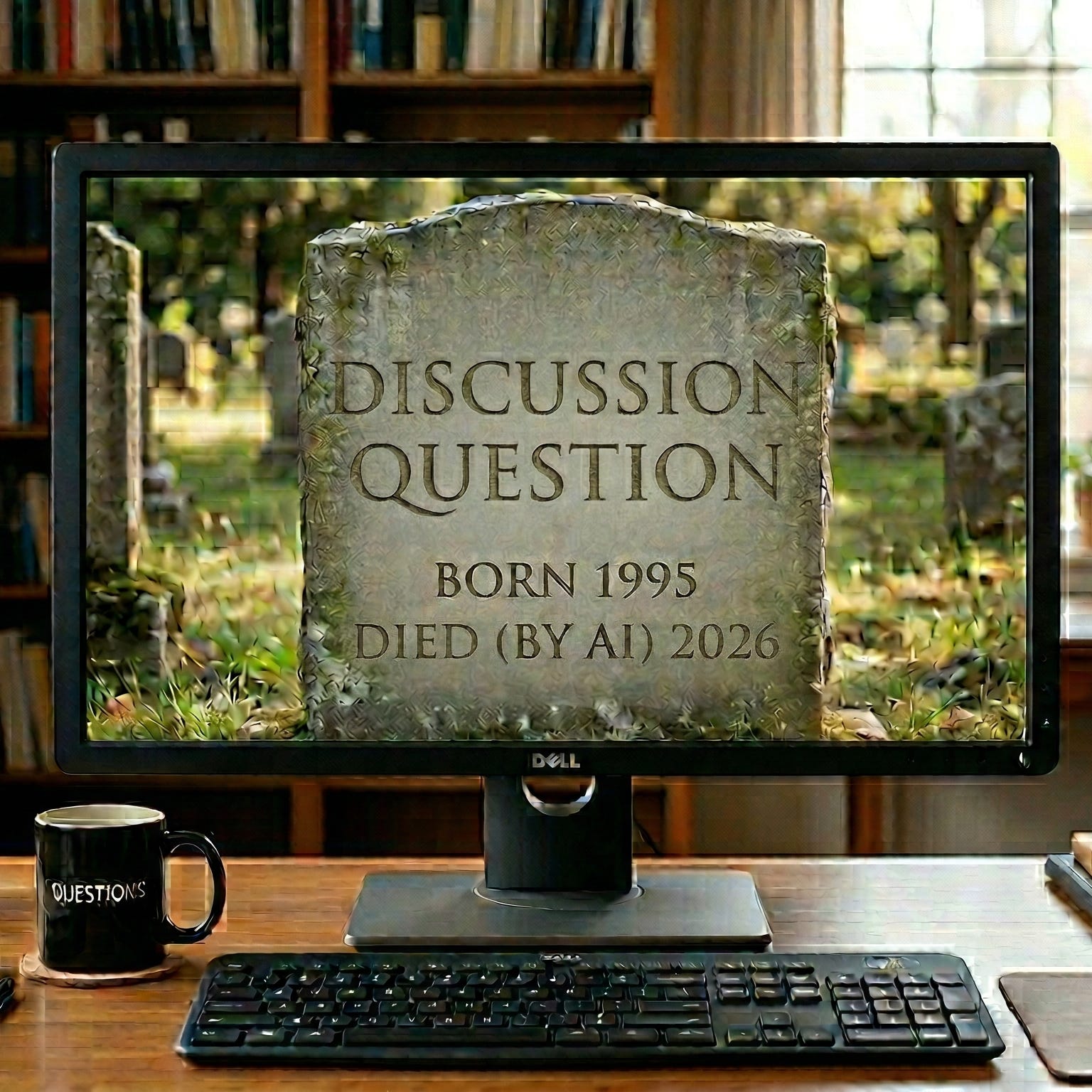
The discussion question (DQ) is a ritual familiar to anyone who has taught or taken an online college course in the last two decades. Maybe first read a chapter or watch a lecture video, and then — dutifully, reluctantly — post a written answer to a DQ thread. The answer has to be substantive and not too short, but not too long. You post something that sounds thoughtful. You must reply to two classmates by a certain day of the week. You receive your participation points. Nobody learns anything particularly profound, and everyone moves on.
That ritual is dying. AI has killed it or will soon. And higher education is only beginning to reckon with what that means to the DQ and virtually everything in the learning management system.
The DQ was already on life support
To be fair, the DQ was never the robust pedagogical tool administrators pretended it was. In theory, asynchronous discussion boards were supposed to replicate the Socratic dialogue of a seminar room — discussions that wrestle with ideas, challenge participants, and build collective understanding. In reality, DQ practice was little more than performative academic writing that students could generate very quickly and very well. Short on insight. Long on filler. Designed to satisfy a rubric, not to think.
Instructors know something is wrong. Students knew it from the start. The system continued on anyway, largely because online teaching programs needed something that looked like engagement, and the discussion board was scalable, easy to grade, and left a paper trail. The rationale was never that DQs unlocked the magic of learning.
Now we have ChatGPT, Claude, Gemini, and a dozen others. And overnight, the time cost of producing a competent, rubric-satisfying discussion post dropped to approximately thirty seconds. It has quickly become the artifice of learning artifacts.
The mistake universities are still making
Here is the uncomfortable truth that many academic VPs and curriculum committees are not yet ready to say out loud: universities have been using discussion boards primarily not to educate students, but to monitor them — AND to monitor faculty.
Discussion posts create artifacts. They demonstrate that a student logged in, engaged with the material, and produced something. They prove — or seemed to prove — that a course was “active.” Administrators could pull engagement reports. Faculty supervisors can create expensive dashboards using glizy business intelligence tools to watch over faculty on the pretense that DQs are the kernel of learning. Accreditors could audit thread counts. The DQ was less a learning tool than a compliance mechanism dressed in the language of pedagogy.
With the arrival of AI, it’s game over for the DQ as we know it
With AI, however, the game is over. When a student can generate a thoughtful, citation-rich, 250-word response to “How does Clayton Christensen’s theory of disruptive innovation apply to the collapse of traditional retail?” in under a minute, the compliance artifact no longer tells you anything about the student. It tells you about their prompting skills, at best.
Doubling down — adding AI detection tools, requiring students to post within specific time windows, demanding webcam-verified responses — is not a solution. It is an arms race that institutions will lose, are already losing, and that corrodes the trust between faculty and students in the process.
How long will it take for enterprising faculty to create automated responses to student answers to feign adequate “engagement” in the online classroom? It’s likely already done.
And a few other things
The death of the discussion question is a symptom, not the disease. The deeper problem is that online higher education has chronically underinvested in the kinds of learning experiences that AI cannot easily replicate: genuine intellectual relationships, productive disagreement, and the friction of being pushed by someone who actually knows you and your thinking.
The problem is greater than DQs. Entire systems of online learning assignments are at risk. The famed 750-word paper--complete with references--can be written by AI in a few minutes. Answers to multiple-choice questions will be readily available even without AI.
We must get beyond the myth of a DQ being the substitute for Socratic dialogue
The rhetoric is there, of course, to keep up the pretense. There are multiple dubious articles claiming that online discussions can somehow mimic “Socratic dialogue” through rich, rapid exchanges.
Online faculty, who are often underpaid adjuncts, were given discussion boards as a substitute for real pedagogical design. Students who were already isolated in asynchronous environments were given thread requirements as a substitute for real community. The DQ wasn’t just a bad assignment — it was a placeholder for something that could never fulfill promises.
A way forward: Real online dialogue
The answer is not to abandon online discussion. It is to redesign it around what AI cannot easily fake: live, authentic, responsive, evolving conversation between specific people about specific ideas.
What this looks like in practice is guided online verbal dialogue — structured, small-group, real-time conversations built around prompts that require students to think while responding to each other, specifically, rather than to an abstract question floating in an empty thread. Not “What do you think about X?” but “Company X attempted to implement the outlined strategy last year — how do you evaluate it and should it be changed?”
This requires students to actually prepare for a discussion and intently listen to what their peers say. It surfaces individual reasoning in ways that are hard to outsource because the conversation is about them — their prior statements, their intellectual growth, their specific disagreements.
Real dialogue is harder to design. It is harder to scale. But it is also what learning actually looks like.
One platform already doing this work seriously is Breakout Learning. Rather than asking students to post to a board, Breakout puts them into live, small-group video discussions — face-to-face, in real time — built around scenario-based content. Students have to articulate ideas verbally, respond to peers on the spot, and reason through follow-up questions in the moment. There is no copy-paste. No prompt engineering. No, quietly running a response through an AI and tweaking the wording.
We have to stop designing assignments that AI can ace. The platform uses AI not to replace the conversation, but to evaluate it — transcribing discussions, applying faculty-defined rubrics, and surfacing comprehension data that actually helps instructors teach better.
That model — live dialogue, AI-assisted evaluation, human accountability at the center — is what post-DQ online education may look like. There is plenty of research to do in this area.
The DQ is dead. The question now is whether universities will replace it with something better, or simply with a more sophisticated version of the same hollow compliance theater — this time, with an AI detector bolted on the side.
Upcoming topics in the Substacks
Ex4EDU.Report - Installments 3 and 4 of Affective the Affective.
EduPartners.news - Thoughts from Taos on Cooperatives and the Credit Card Tax.
About the Ex4EDU.Report and EduPartners.news
This report is offered as a free-of-charge contribution by Lone Tree Academics LLC an educational services company dedicated to transformation in higher education. Our services are focused on solutions for the development of institutional and program strategies, crafting engaging LearningScapes™, and developing programs of the scholarship of teaching and learning.
We are also founders of the EduPartners.coop LCA, which supports and sends the newsletter EduPartners.news, which is focused on furthering the use of cooperative and collaborative organizations in higher education.