


2026:3
Key Takeaways
ISO’s new Integrated Management System (IMS) is positioned as a potential replacement for accreditation, allowing organizations to bundle standards such as ISO 21001, 29993, and 29994 for simultaneous certification of multiple education offerings.
This IMS bundle offers the potential for a faster, more affordable, and superior alternative to the often slow, clumsy, and costly traditional accreditation alternatives.
By leveraging the bundled IMS model, institutions can achieve triple certification across multiple programs in a single 12- to 18-month cycle.
ISO certification may offer greater international recognition than traditional accreditation models, serving as a vital marker of quality and credibility in rapidly growing higher education markets.
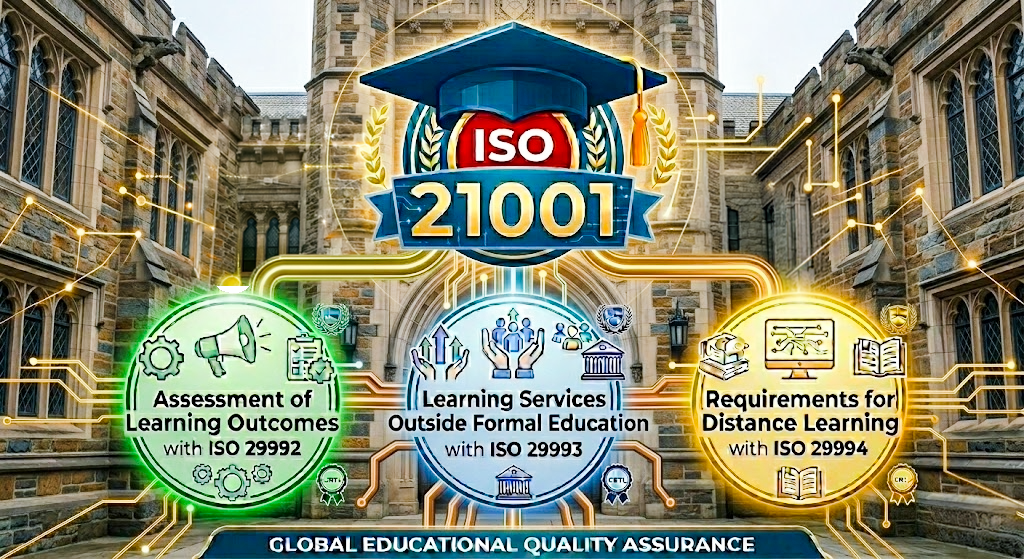
There is a small rectangular block of text appearing on an increasing number of institutional education websites, brochures, and tender submissions in the education sector. It says “ISO 21001 Certified” or “ISO 29993 Certified,” and most people in Western educational institutions have no idea what it means. In Dubai, Chennai, Riyadh, Singapore, and Kuala Lumpur, they do. That asymmetry is worth paying attention to. Something recently, however, has changed the equation.
Replacing clumsy, slow, and costly
Many institutions experience accreditation as clumsy, slow, and costly. The complaints are often that the standards and criteria are vague, leading to decisions that reflect clubiness rather than real results. Accreditation examiners and evaluators are often selected based on their embeddedness in the accreditation club rather than their evaluation prowess. Agility is seldom used to describe the accreditation process.
With the issuance of ISO 21001 in 2018 and its reissuance in 2025, the International Organization for Standardization (ISO) provided the foundation for an integrated set of higher education management system standards. The group is rounded out with ISO 29992, ISO 29993, and ISO 29994. As noted in my article, ISO Alongside, Instead, or Inside? The potential of ISO 21001:2018 to change and challenge higher education accreditation, and a post to the Ex4EDU.report, Beyond the painted mess of education quality, there is a potential for this collection of ISO standards to displace accreditation as we know it today.
What has changed—The IMS bundle
Recently, ISO issued guidance on integrating multiple standards under a single umbrella, with the publication of its Integrated Management Systems guidance. In this new practical guide, ISO has described a system for integrating, or “bundling,” multiple standards towards a contemporaneous certification. The focus of the Integrated Management System (IMS) is on process-based consistency. By bundling related educational standards, ISO’s IMS concept has moved from a potential companion to accreditation to its replacement.
The Bundle Play: Three+ Standards, One System
There is a practical implication of the IMS leveraging the educational technical committee’s (TC232) expertise that illustrates a truth many institutions — even those actively pursuing individual certifications — have not yet grasped. Because ISO 21001, ISO 29993, and ISO 29994 all share the same Harmonized Structure (the ten-clause framework, called Annex L, that underpins all modern ISO management system standards), they are purpose-built to run together and easily combined using the IMS approach. Under the integrated approach, there is no need for three separate quality manuals, internal audit programs, or certification audits. Institutions need one integrated management system, mapped across the scope of educational operations and processes, with a single audit cycle that covers all applicable standards simultaneously.
Unlike traditional accreditation, the ISO-IMS “bundle play” works across degree programs, continuing professional development courses, and online short courses.
As a recap, the key standards that could be bundled are shown in the table below.
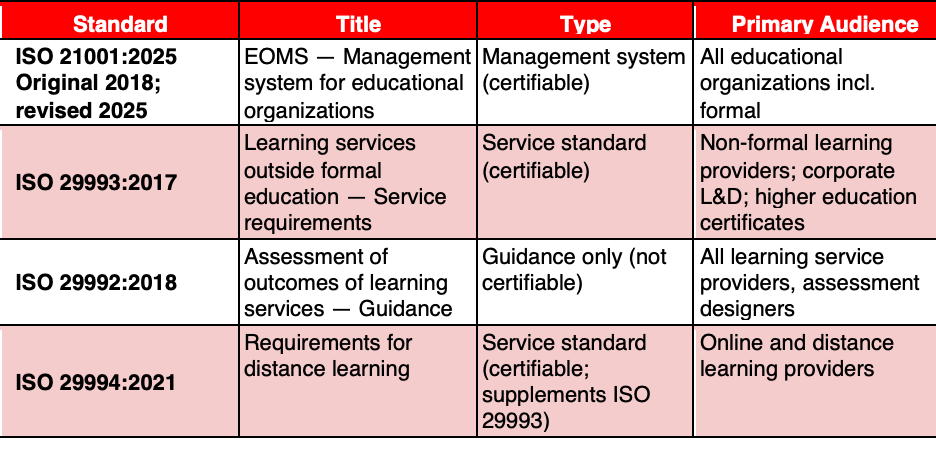
What does this mean in practice? An institution that delivers degree programs, continuing professional development courses, and online short courses is simultaneously in scope for all four TC 232 standards. Under an integrated management system, that institution can pursue a triple certification — ISO 21001, ISO 29993, ISO 29994 — in a single implementation cycle, typically running 12 to 18 months from gap analysis to certificate issuance.
A single lead auditor, familiar with the harmonized structure, can cover the common clauses once and then address the standard-specific requirements in sequence. Certification bodies, including BSI, TÜV SÜD, DEKRA, Intertek, and Bureau Veritas, already have the technical competence to conduct these combined audits. The infrastructure exists now.
The cost comparison with clumsy, slow, and expensive accreditation is stark
A full institutional accreditation cycle with a U.S. regional body or a recognized international accreditor such as AACSB, ACBSP, ABET, or WASC typically involves candidate fees, self-study preparation costs, peer review visits, and ongoing membership fees that collectively run to six figures over a five-to-seven-year cycle — before accounting for the internal staff time involved. The processes are designed around a periodic comprehensive review rather than continuous improvement. An integrated ISO certification covering a TC 232 bundle using IMS can typically be achieved for a fraction of that cost, with periodic surveillance audits that maintain ongoing accountability rather than waiting years for the next major review.
In summary, faster, cheaper, and better.
Where the action is
ISO 21001 was first issued in 2018. As with any new standard, adoption takes time. A few years in, however, the pattern of adoption is striking. And with the revised edition, ISO 21001:2025, the conversation is only getting louder.
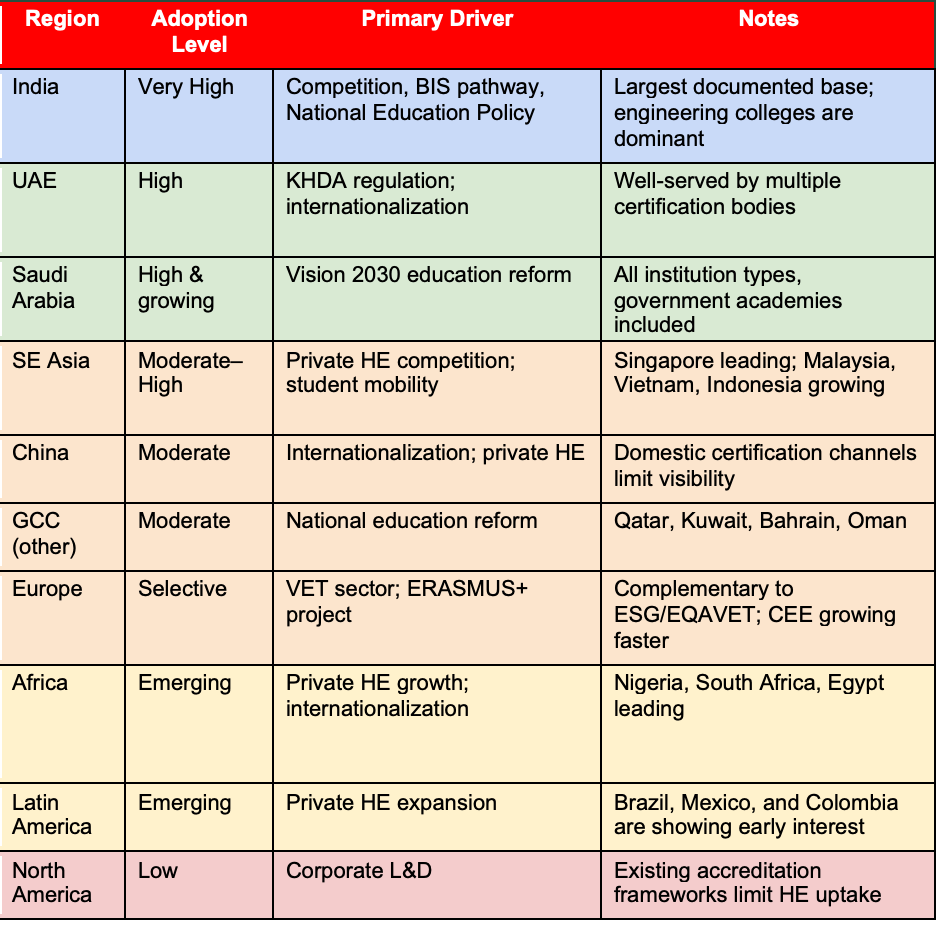
The largest documented base of ISO 21001 certifications is in India. Engineering colleges and technical universities — competing ferociously for students and employer recognition in one of the world’s most competitive and saturated private higher-education markets — have pursued certification in growing numbers. The Bureau of Indian Standards created a nationally recognized certification pathway alongside the international one, lowering the cost barrier and giving domestic institutions a credible signal of quality. The Indian consulting ecosystem around ISO 21001 is now mature and well-priced.
The Gulf countries represent another high-potential market. In the UAE, the Knowledge and Human Development Authority — which regulates Dubai’s private schools — has created a regulatory environment in which quality management frameworks are expected rather than exceptional. International school networks, premium nursery chains, and branch campuses of UK and Australian universities operating in the Gulf are all pursuing certification as a competitive differentiator and, increasingly, a procurement requirement. In Saudi Arabia, Vision 2030’s education reform program has made quality management frameworks a marker of institutional seriousness. Schools, universities, training centers, and government academies are all in scope.
Europe’s story is more nuanced. Adoption is selective. The strongest trend runs through vocational education and training, where an ERASMUS+-funded project called VET21001 systematically mapped ISO 21001 onto the European EQAVET quality assurance framework and piloted it across multiple member states. For VET providers, ISO 21001 offers an internationally legible quality signal that domestic frameworks do not provide. Higher education institutions, already burdened by ENQA membership, program accreditation, and national quality agencies, have been slower to add another framework. Central and Eastern Europe, where domestic quality assurance infrastructure is less mature, demonstrates stronger potential vis-à-vis the traditional Western European landscape.
A quick summary of our adoption research is in the table below.
Why? What the numbers say
The reasons institutions may pursue the IMS bundle are the same as for accreditation: recognition of quality by funding and regulatory agencies, improved competitive position with prospective students, partnerships with external stakeholders such as employers, and improved student satisfaction. The ISO bundle approach can deliver on all of these areas across a range of educational products.
Over 60% of certified institutions report measurable gains in learner satisfaction and operational efficiency within two years of certification. Vocational institutes have documented improvements in learner satisfaction from 82% to 94%, scheduling errors down by 40%, and administrative costs reduced by 20%. Technical colleges report average completion rate improvements of 18%. E-learning providers have documented improvement in course completion in digital classrooms. These figures come largely from case studies by various certification bodies and should be read with appropriate caution regarding selection bias. But the benefits and direction of effect are consistent across documented cases.
The certification market for educational quality management was valued at USD 16 billion in 2024 and is projected to reach USD 66 billion by 2034. That is not a niche segment and has real potential. Embracing a faster, cheaper, better solution with the ISO-IMS bundle offers a strong win-win option.
U.S. accreditation models are waning in appeal
In international higher education, there is a common retort that the U.S. accreditation model is the gold standard to be emulated globally. Despite the rhetoric, the appeal largely stops at the U.S. border. In the geographic areas driving global growth in private and professional education — South and Southeast Asia, the GCC, Sub-Saharan Africa, and Latin America — U.S. regional or institutional accreditation brand names are largely unknown or carry little weight with regulators, employers, and families. Few specialized accreditors have much of a foothold outside the U.S.
The United States is conspicuously absent from ISO adoption in higher education, and the reason is revealing.
Within the U.S. market, this ecosystem works. American regional accreditation — the HLC, SACSCOC, WASC, and their peers — carries enormous institutional and regulatory credibility domestically. Accreditation is the financial gateway to substantial Federal funding. State licensing often depends on it. Hiring managers at American companies understand it. Those drivers push U.S. institutions into the American accreditation system and away from international norms. Outside the country, however, the domestic regulatory burden is unwelcome and unneeded.
A prospective student in Riyadh or Jakarta does not instinctively reach for U.S. News & World Report rankings or know what the historic term of “regionally accredited” means. They do, increasingly, understand what an international quality standard such as ISO signifies — particularly when their government has incorporated it into procurement or licensing criteria.
The ISO-IMS bundle is built for cost-effective, cross-border appeal
ISO certification, unlike American accreditation, is designed from the ground up for cross-border legibility. That is a structural advantage that will compound over time as ISO adoption gains in high-growth education markets. It is one that U.S. institutions have been slow to reckon with.
The strategic implications
There is a steady but real shift happening in how educational quality is viewed. In the markets that will drive future global growth in education — South and Southeast Asia, the Middle East, parts of Africa, and Latin America — ISO certification is becoming part of the language of institutional credibility. Governments use it as a procurement filter. Parents use it as a trust signal. Employers, who often implement ISO management standards in their operations, can use the standards as a proxy for graduate readiness.
The question for institutions not yet engaged with it is not whether to pay attention, but how much runway they still have before they are behind competitively.
ISO 21001:2025’s revision, which now explicitly incorporates digital and blended learning, measurable learner outcomes, SDG 4 alignment, and AI integration into the standard’s framework, signals that this is not just a passing fad. The IMS bundle makes the model more complete and attractive. One can clearly see adoption rates accelerating in the near future.
This post draws on LT Academics’ analysis of the implementation of ISO/TC 232 standards across geographic regions, institution types, and certification dates. As noted above, some of the data should be read as anecdotal but directionally supportive of the trends identified.
About the Ex4EDU.Report and EduPartners.news
This report is offered as a free-of-charge contribution by Lone Tree Academics LLC an educational services company dedicated to transformation in higher education. Our services focus on developing institutional and program strategies, crafting engaging LearningScapes™, and developing programs in the scholarship of teaching and learning.
We are also founders of the EduPartners.coop LCA, which supports and authors the newsletter EduPartners.news, focused on furthering the use of cooperative and collaborative organizations.